

The Federal Government's battery program got a massive boost; but the rules are about to shift dramatically.

The $5 Billion Dollar Plot Twist
Instead, homeowners went absolutely wild.
Installations skyrocketed from 200 per day to over 1,500. In just six months, Australians added more battery storage to the grid than existed in the entire country previously. The government's original $2.3 billion budget was on track to be completely exhausted by June 2026, three and a half years early.
Energy Minister Chris Bowen faced a choice: let the most popular energy program in Australian history go bankrupt, or find more money.
He chose option three: inject a massive $5 billion to keep the program alive until 2030, but fundamentally change who benefits most
What's Actually Changing!
Right now, the rebate is beautifully simple: the government pays roughly $320 for every kilowatt-hour (kWh) of storage you install. Bigger battery? Bigger rebate. It's like a supermarket discount that increases the more you buy.
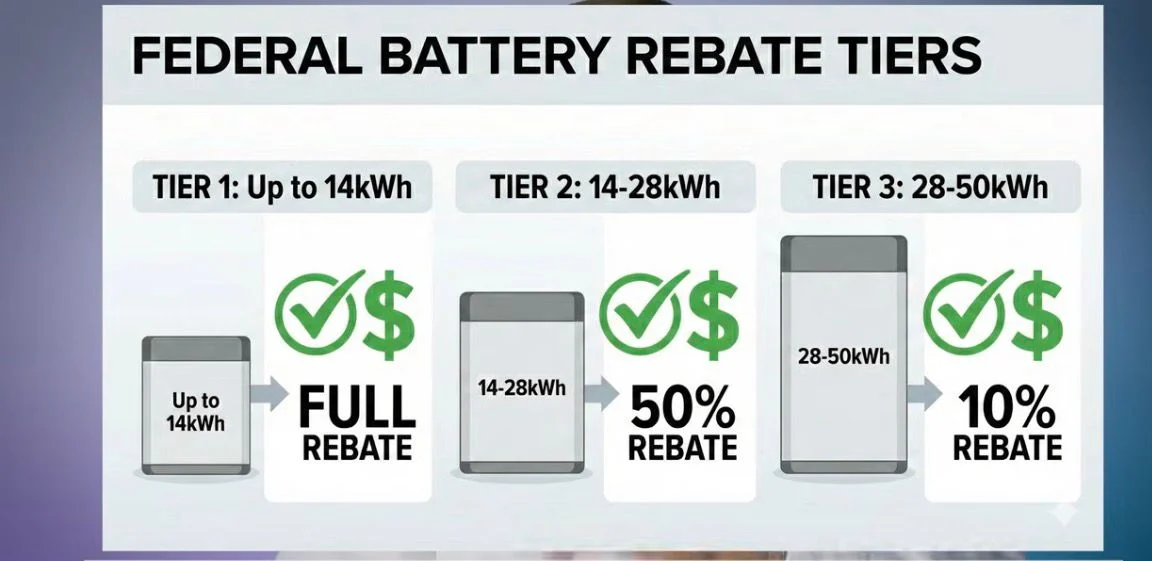
Starting May 1st, that changes to a "tiered" system; think of it like tax brackets, but in reverse:
The New Three-Tier System
Tier 1 (0-14 kWh): Full rebate at 100%. This is the "sweet spot" the government wants to encourage.
Tier 2 (14-28 kWh): Reduced rebate at 60% of the standard rate.
Tier 3 (28-50 kWh): Minimal rebate at just 15% of the standard rate.
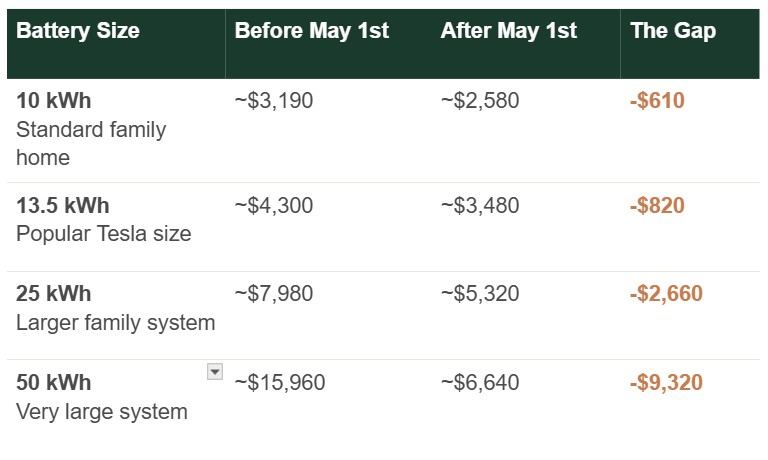
Here's what this means in actual dollars for Sydney families:
Who Should Act Now, and Who Can Wait
Act Before May 1st If You're Planning...
A battery larger than 14 kWh
The savings difference is significant. A 20 kWh system loses over $2,600 in rebate value after May 1st. If you've been eyeing a larger system to handle pool pumps, air conditioning, or electric vehicle charging, install before the deadline.
Upgrading an existing solar system
If you already have solar panels and want to add storage, the current rebate structure is more generous for all sizes. Lock it in now.
A complete solar + battery package
Combining solar and battery rebates still works beautifully under current rules. The state government's solar rebate hasn't changed, but the federal battery rebate is about to.
The May 1st Changes Won't Hurt You Much If...
You're Planning a Standard 10-13.5 kWh System
Good news: you're in the government's "sweet spot." While the rebate does drop by roughly $600-800, you'll still get strong support. The tier system was designed to favor sensible, right-sized systems like yours.
You can still benefit by acting before May 1st, but the urgency isn't as dramatic as it is for larger systems.
Which Battery Brands Maximize the 14 kWh Tier?
Smart Sydney families are now asking: "Which batteries sit right at that 14 kWh threshold to get full rebate coverage?"
Here are the top performers available in Australia that make the most of Tier 1 (100% rebate):
Tesla Powerwall 2
13.5 kWh
Australia's most popular battery. Proven reliability, excellent app, strong resale value.
I-Store
2 X 7 kWh
Modular design. Can expand later if needed without losing initial rebate benefits.
Empower
14 kWh
Excellent value. Australian company support. Great warranty terms.
Sonnen Batterie Evo
10 kWh
Premium German engineering. Longest warranty in the market (25 years).
Signergy
8 + 5 13 kWh
Flexible sizing. Strong performance in Sydney conditions.
Anker Solix 1
2 x 5 10.08 kWh
Modular AC-coupled system. Perfect for retrofit installations.
When Is a Larger Battery Still Worth It?
Even with reduced rebates after May 1st, there are still situations where going bigger makes financial sense:
- You have an electric vehicle
Charging a Tesla or other EV overnight from your battery instead of the grid can save $3,000+ annually on fuel costs. A 20-25 kWh system handles both home and car charging.
- You run a home business
If you're using power throughout the day (home office, workshop, daycare), larger storage pays for itself faster. The rebate drop is offset by higher daily savings.
- You live in an area with frequent outages
Parts of Sydney's outer suburbs experience multiple blackouts yearly. A larger battery provides genuine energy security worth more than the rebate difference.
- You're planning to eliminate gas completely
Electric cooking, hot water, and heating increase daily usage significantly. A 20-25 kWh battery ensures you can run everything from stored solar instead of grid power at 45¢/kWh.
The Bottom Line on Large Systems
Even after May 1st, the rebate doesn't disappear, it just becomes less generous for larger sizes. If your home genuinely needs 20 + kWh of storage, the math still works. Just expect your payback period to extend by 6-18 months depending on size.
The Hidden Trap: Installation Backlogs
Here's the detail that's catching families out: the rebate is locked in by installation date, not contract date.
Quality installers across Sydney are already booking 6-8 weeks out. If you sign a contract in March but your installer can't get to you until May 2nd, you'll be subject to the new lower rebate structure, potentially costing you thousands.
What Good Earth Group Is Doing About This
We're prioritizing pre-May installations for customers who commit by mid-February. Our installation crews are working extended hours through April to ensure families who want to act can actually get installed before the deadline.
Current availability: Contracts signed by February 15th can be guaranteed April completion.
Your Action Plan: Three Simple Steps
1. Calculate Your Actual Needs
Don't buy storage you won't use. Check your last six power bills. How much are you using during peak evening hours (typically 4-10pm)? That's your target battery size. Most Sydney families need 10-15 kWh.
2. Get Quotes Now, But Choose Quality
Avoid "too good to be true" Facebook ads offering $4,000 systems. These cowboys won't be around in 3 years when you need warranty support. Look for CEC-accredited installers, local businesses with track records, and batteries from established brands.
3. Lock in Installation Dates
If you're going larger than 14 kWh, confirm in writing, that installation will happen before May 1st. Build in buffer time for weather delays or supply issues.
The Bigger Picture: Why This Actually Matters
Yes, this is about saving money on power bills. But there's something more significant happening.
Australia's aging coal power plants are failing. The Australian Energy Market Operator predicts their reliability will drop to just 75% in the next few years. Without a dramatic increase in grid storage, we're facing regular blackouts across Sydney and beyond.
The government isn't just helping you save money; they're crowdsourcing a $20 billion grid upgrade by supporting families to install their own backup power. Your Tesla Powerwall or BYD battery isn't just running your fridge during outages; it's becoming part of a "virtual power plant" that keeps the lights on for your entire neighborhood.
That's why the rebate now requires "VPP-capable" equipment. You don't have to join a virtual power plant program immediately, but your battery must have the technical ability to share power with the grid during emergencies.
The thing about energy independence is this: it's not just about your electricity bill. It's about resilience. When everyone said the program was too successful and needed to be cut, the government instead tripled down and committed $7.2 billion over 10 years. They know that distributed energy, your solar panels, your batteries, your household becoming its own mini power station, is the only realistic path to a reliable grid.